Why the most effective boards look beyond impressive résumés to find leaders with the judgment, experience, and strategic perspective to shape an organization’s future.
A seat on a board of directors is one of the most influential positions a business leader can hold. It represents an opportunity to shape strategy, strengthen governance, guide executive leadership, and influence decisions that can determine an organization’s long-term success.
But earning that seat requires more than an impressive résumé, an executive title, or decades of professional experience.
The qualifications that make someone a successful executive are not necessarily the same qualifications that make someone an effective board director.
As organizations navigate technological disruption, economic uncertainty, changing stakeholder expectations, and increasingly complex risks, the definition of a qualified board member is evolving.
Today’s boards need individuals who can do more than offer advice. They need leaders who can exercise independent judgment, challenge assumptions, anticipate risks, and contribute meaningful strategic insight.
The question is no longer simply whether someone has the experience to serve on a board. It is whether that experience can help the organization make better decisions about its future.
1. Executive Experience Matters, but Strategic Perspective Matters More
Executive leadership experience remains one of the most valuable qualifications for board service.
Individuals who have led organizations, managed complex operations, overseen financial performance, or navigated major business transformations bring practical knowledge to the boardroom.
However, executive experience alone does not guarantee board effectiveness.
Board directors must be able to transition from managing daily operations to providing strategic oversight.
This distinction is critical.
Executives are responsible for implementing strategy. Board members are responsible for evaluating strategy, overseeing management, and ensuring that organizational decisions support long-term objectives.
An effective director understands when to challenge leadership, when to provide guidance, and when to allow management to execute.
The strongest candidates demonstrate an ability to see beyond immediate operational challenges and consider the broader implications of business decisions.
Board qualification is not simply about what you have managed. It is about how effectively you can evaluate what others are managing.
2. Financial Literacy Is a Fundamental Requirement
Every board member should possess a working understanding of financial performance, regardless of professional background.
Directors are expected to oversee financial health, evaluate major investments, understand organizational risks, and assess whether resources are being allocated effectively.
This requires the ability to interpret financial statements, recognize important performance indicators, and ask informed questions about profitability, liquidity, cash flow, and long-term financial sustainability.
Not every director needs to be a financial expert. However, every director should be financially literate enough to fulfill their oversight responsibilities.
For candidates with specialized financial backgrounds, experience in accounting, auditing, capital markets, mergers and acquisitions, or corporate finance can provide additional value.
The objective is not to turn every director into a chief financial officer.
It is to ensure that board members understand the financial consequences of the decisions they oversee.
3. Industry Expertise Must Be Balanced With Broader Business Insight
Industry knowledge can make a board candidate particularly attractive.
Directors who understand a company’s competitive environment, regulatory landscape, customer expectations, and emerging market trends can help leadership identify opportunities and anticipate challenges.
Yet organizations also benefit from directors whose experience extends beyond their immediate industry.
A technology executive serving on a manufacturing board, for example, may offer valuable insight into automation, digital transformation, and emerging business models.
Similarly, a leader with international experience may help a domestic organization evaluate expansion opportunities or navigate global supply chain challenges.
The most effective boards balance industry familiarity with complementary perspectives.
This is why board composition should be evaluated collectively rather than simply by assessing individual credentials.
A highly qualified candidate may still be the wrong addition if their expertise duplicates capabilities already well represented on the board.
The value of a board member is determined not only by what they know, but also by what their knowledge adds to the collective decision-making process.
4. Governance Knowledge Separates Board Candidates From Board-Ready Leaders
One of the most overlooked board qualifications is a practical understanding of corporate governance.
Serving on a board involves specific responsibilities that differ from those associated with executive leadership or advisory roles.
Directors must understand fiduciary duties, oversight responsibilities, conflicts of interest, confidentiality, and the relationship between the board and management.
They must also recognize that governance expectations vary depending on the organization’s structure, jurisdiction, and regulatory environment.
A candidate who understands these responsibilities enters the boardroom better prepared to contribute.
For aspiring directors, governance education, board development programs, and relevant committee experience can help demonstrate readiness.
Previous board experience can be valuable, but it should not automatically become a barrier to entry.
Organizations that insist exclusively on experienced directors risk overlooking talented leaders with the capabilities and perspective to strengthen the board.
The better question is whether a candidate understands the responsibilities of governance and demonstrates the judgment required to fulfill them.
5. Independent Judgment Is More Valuable Than Agreement
Boardrooms need constructive debate.
Directors are not appointed merely to validate management decisions or reinforce the opinions of other board members.
They are expected to exercise independent judgment and evaluate important issues objectively.
This requires intellectual confidence, professional courage, and the ability to disagree respectfully.
A qualified director should be comfortable asking difficult questions, challenging assumptions, and raising concerns when necessary.
However, independence should not be confused with confrontation.
Effective directors know how to challenge ideas without undermining relationships.
They understand that the purpose of disagreement is not to win an argument but to improve the quality of a decision.
Boards become stronger when directors contribute perspectives that might otherwise go unexamined.
The most valuable voice in the boardroom is not always the loudest or most experienced. Sometimes it is the one willing to ask the question everyone else has overlooked.
6. Leadership Character and Emotional Intelligence Are Essential
Technical qualifications may open the door to board opportunities, but character determines how effectively someone contributes once inside.
Integrity, accountability, discretion, and sound judgment are foundational qualities of responsible board leadership.
Directors frequently encounter sensitive information, competing priorities, and decisions involving significant organizational consequences.
They must demonstrate the ability to act in the organization’s best interests while maintaining professional objectivity.
Emotional intelligence is equally important.
Board members work with individuals who bring different personalities, professional experiences, and perspectives to the table.
The ability to listen carefully, manage disagreement, communicate clearly, and build productive relationships contributes directly to board effectiveness.
A director who possesses exceptional technical expertise but struggles to collaborate may weaken the board’s collective performance.
Conversely, someone who combines expertise with humility and strong interpersonal judgment can elevate the entire boardroom.
Leadership maturity is not measured by how much authority someone commands.
It is reflected in how responsibly they exercise influence.
7. Digital and Technological Fluency Is Becoming a Boardroom Priority
Technology is no longer a subject reserved for information technology departments.
It influences nearly every aspect of organizational strategy, including customer experience, operational efficiency, cybersecurity, workforce development, and competitive positioning.
Artificial intelligence, data governance, digital transformation, and cybersecurity have become significant board oversight considerations.
As a result, directors who understand the strategic implications of emerging technologies can provide meaningful value.
This does not mean every board member must possess deep technical expertise.
It does mean directors should be capable of asking informed questions about technological investment, digital risks, organizational readiness, and the potential impact of innovation.
Boards that lack technological awareness may struggle to recognize emerging threats or evaluate transformative opportunities.
The most qualified candidates demonstrate both curiosity and adaptability.
They understand that professional expertise must continue evolving as the business environment changes.
8. Risk Management Experience Strengthens Strategic Oversight
Every significant business opportunity carries some degree of risk.
Boards must help organizations understand those risks while ensuring that management has appropriate systems for identifying, assessing, and responding to them.
Candidates with experience in enterprise risk management, regulatory compliance, cybersecurity, crisis leadership, or organizational transformation can bring important capabilities to the boardroom.
However, effective risk oversight requires more than identifying potential problems.
It requires understanding the relationship between risk and strategic opportunity.
A board that avoids every risk may prevent innovation and growth.
A board that ignores risk may expose the organization to unnecessary harm.
Qualified directors help leadership navigate the balance between protecting organizational interests and pursuing opportunities that create long-term value.
They recognize that effective governance is not about eliminating uncertainty.
It is about making informed decisions despite uncertainty.
9. Communication Skills and Collaborative Leadership Drive Board Effectiveness
Board members often possess significant expertise, but expertise creates limited value if it cannot be communicated effectively.
Successful directors know how to translate complex information into clear strategic insights.
They ask thoughtful questions, listen actively, and contribute to discussions without dominating them.
They also recognize the importance of preparation.
Board meetings are not opportunities to encounter important information for the first time.
Qualified directors review materials in advance, understand the issues under consideration, and arrive ready to participate in meaningful discussion.
They respect the distinction between oversight and management and maintain productive working relationships with fellow directors and executive leadership.
Board service requires the ability to influence decisions without relying on direct operational authority.
That makes communication, collaboration, and professional discipline essential qualifications.
10. Commitment and Availability Are Often Underestimated
A board appointment may carry prestige, but it also carries responsibility.
Effective board service requires time, preparation, ongoing education, and consistent engagement.
Directors may need to participate in scheduled meetings, committee work, strategic planning sessions, and additional discussions during periods of organizational change or crisis.
Candidates should carefully assess whether they can meet these expectations alongside their existing professional commitments.
Organizations should likewise evaluate a candidate’s availability rather than assuming that an accomplished executive will automatically have sufficient time to serve.
An impressive professional background offers little benefit if the director cannot participate meaningfully.
Board service should never be treated as a résumé achievement. It is an ongoing commitment to organizational stewardship.
What Organizations Should Look for When Selecting Board Members
The most effective board recruitment processes begin with organizational needs rather than candidate prestige.
Before identifying potential directors, organizations should evaluate their current board composition, strategic priorities, governance requirements, and anticipated challenges.
This assessment can reveal gaps in expertise, experience, and perspective.
A company preparing for international expansion may benefit from directors with global operating experience.
An organization undergoing digital transformation may prioritize technology and cybersecurity expertise.
A business navigating complex regulatory requirements may seek candidates with relevant legal, compliance, or risk management experience.
The goal is to develop a board whose collective capabilities align with the organization’s present responsibilities and future direction.
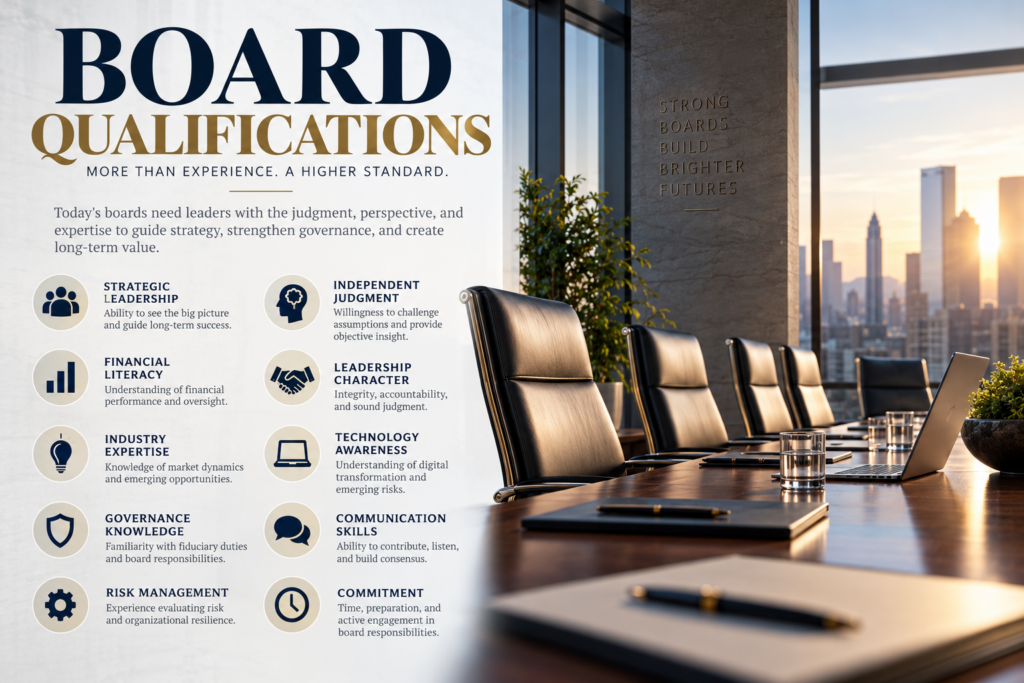
| Qualification | What Organizations Should Evaluate |
|---|---|
| Strategic leadership | Ability to assess long-term opportunities and challenges |
| Financial literacy | Understanding of financial performance and oversight |
| Industry knowledge | Relevant market, customer, and competitive insight |
| Governance expertise | Understanding of fiduciary and oversight responsibilities |
| Independent judgment | Willingness to challenge assumptions constructively |
| Leadership character | Integrity, accountability, and professional discretion |
| Technology awareness | Understanding of digital opportunities and risks |
| Risk oversight | Ability to evaluate uncertainty and organizational exposure |
| Collaboration | Communication, preparation, and interpersonal effectiveness |
| Commitment | Availability and willingness to remain actively engaged |
A structured evaluation process helps organizations select directors based on meaningful contributions rather than titles, relationships, or reputation alone.
How Aspiring Directors Can Strengthen Their Board Qualifications
For executives seeking their first board appointment, the path begins with understanding the difference between executive accomplishment and board readiness.
An effective starting point is to identify the specific expertise and perspective that would make them valuable to an organization.
Candidates should be able to articulate their contribution beyond their current job title.
For example, an executive might offer experience in scaling operations, navigating acquisitions, developing international markets, leading organizational transformation, or overseeing complex financial decisions.
Aspiring directors can strengthen their candidacy by pursuing governance education, gaining relevant nonprofit or advisory board experience, developing relationships within board leadership networks, and demonstrating thought leadership in their areas of expertise.
They should also prepare a board-focused résumé that emphasizes strategic achievements, governance-relevant experience, and measurable organizational impact.
Most importantly, they should approach board opportunities with a service mindset.
The objective is not simply to secure a board seat.
It is to become the kind of leader whose perspective, judgment, and commitment make an organization stronger.
The Future of Board Qualifications: From Credentials to Contribution
Board qualifications are evolving because the responsibilities of boards are evolving.
Organizations face a business environment characterized by rapid innovation, economic complexity, emerging risks, and heightened expectations for responsible leadership.
Traditional indicators of professional success remain important, but they are no longer sufficient on their own.
The strongest boards increasingly need a combination of strategic thinking, financial understanding, governance knowledge, technological awareness, independent judgment, and collaborative leadership.
For organizations, this means approaching director selection as a strategic investment in long-term performance.
For aspiring directors, it means recognizing that board readiness is developed through continuous learning, intentional preparation, and demonstrated leadership judgment.
Ultimately, the qualifications that matter most are those that translate into meaningful organizational value.
A board seat may be earned through experience, but its value is proven through contribution.
And in an increasingly complex business world, the organizations that recognize that distinction will be better positioned to build boards capable of guiding not just today’s decisions, but tomorrow’s success.
#BoardQualifications, #BoardOfDirectors, #BoardLeadership, #CorporateGovernance, #BoardReadiness, #ExecutiveLeadership, #BoardRecruitment, #BoardEffectiveness, #StrategicLeadership, #LeadershipDevelopment, #CorporateBoards, #BoardOpportunities, #ExecutiveDevelopment, #boardsi