In today’s volatile business environment, board seats are no longer honorary positions reserved for past success. They are high-stakes leadership roles that demand continuous learning. As regulatory complexity increases, stakeholder expectations rise, and disruption accelerates across industries, board education has become a strategic necessity—not a professional luxury.
The most effective boards are no longer defined by pedigree alone. They are defined by preparedness.
The New Reality Of Board Service
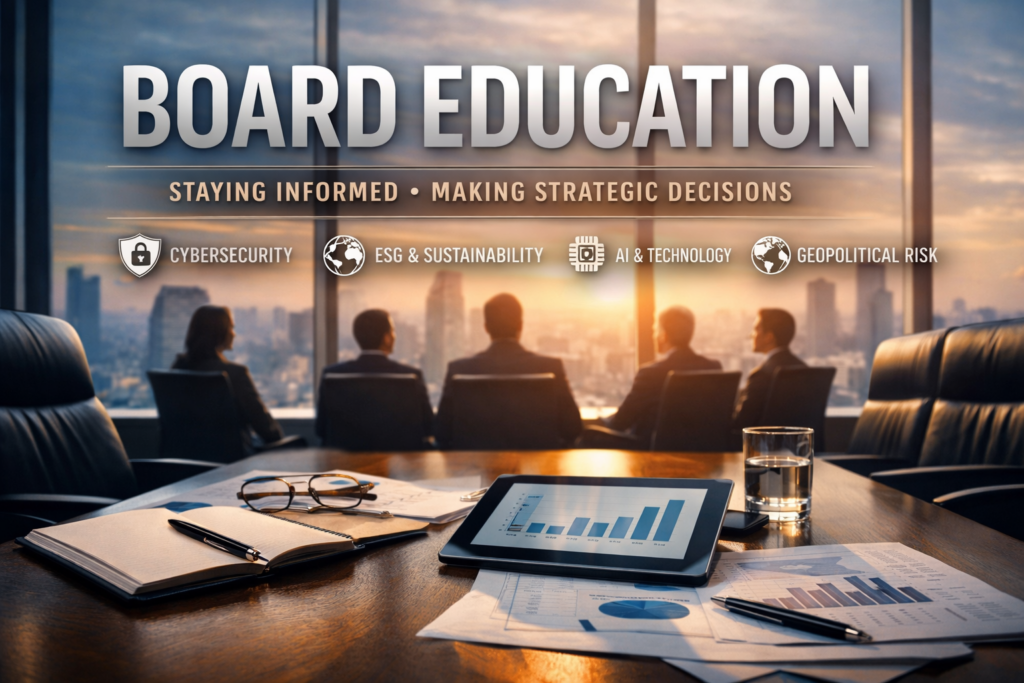
Modern boards are expected to oversee far more than financial performance. Cybersecurity risk, ESG accountability, talent strategy, AI governance, activist investors, and geopolitical exposure are now standard agenda items. Yet many directors were trained in an era when fiduciary oversight and quarterly reporting dominated boardroom discussions.
That gap between historical experience and current responsibility is precisely where board education plays a critical role.
High-performing boards treat education the same way elite organizations treat leadership development: as an ongoing discipline, not a one-time credential.
What Board Education Really Means
Board education is not about generic governance theory. At its best, it equips directors with three essential capabilities:
Contextual awareness: Understanding how macro trends—technology, regulation, labor markets, and global risk—impact the organization’s long-term strategy.
Role clarity: Knowing where governance ends and management begins, and how to challenge constructively without crossing into operations.
Decision readiness: Developing the judgment to act decisively in ambiguous, high-pressure situations.
Education sharpens a director’s ability to ask better questions, recognize weak signals early, and contribute meaningfully beyond their functional expertise.
Core Categories Of Board Education Resources
Not all board education is created equal. The most valuable resources typically fall into five categories.
1. Formal Director Education Programs
Universities and governance institutes offer structured programs covering fiduciary duties, audit and compensation oversight, crisis governance, and emerging risks. These programs provide a common language for directors and are especially valuable for first-time board members or executives transitioning from management to governance roles.
2. Industry-Specific Briefings
Sector-focused education helps directors understand competitive dynamics, regulatory nuances, and innovation cycles unique to the industries they serve. A healthcare board, for example, faces vastly different risks than a SaaS or manufacturing board. Relevance matters.
3. Peer Learning And Director Forums
Some of the most practical board education happens outside the classroom. Private peer forums, director roundtables, and advisory councils allow board members to learn from real-world experiences—what worked, what failed, and what leaders wish they had seen sooner.
4. Continuous Intelligence Platforms
Modern boards increasingly rely on curated insights: governance updates, regulatory alerts, investor sentiment analysis, and technology risk briefings. These resources help directors stay current between meetings rather than reacting after issues escalate.
5. Board-Level Simulations And Scenario Planning
Advanced boards use simulations to stress-test decision-making around crises, succession failures, activist challenges, or cyber incidents. These exercises build muscle memory and expose gaps in governance processes before real consequences emerge.
The Role Of Boards In Their Own Education
One of the most overlooked aspects of board education is ownership. Effective boards do not outsource learning entirely to individual directors. They embed education into board culture.
This includes dedicating agenda time to learning, conducting regular board and committee assessments, onboarding new directors intentionally, and aligning education priorities with the organization’s strategic horizon.
When education is treated as a board responsibility rather than a personal add-on, governance quality improves measurably.
Education As A Competitive Advantage
Well-educated boards make better strategic decisions, attract stronger executive talent, and earn greater trust from investors and stakeholders. They are more confident in times of uncertainty because they understand the terrain.
In contrast, boards that neglect education often default to hindsight governance—responding to issues after damage is done.
In a business environment defined by complexity and speed, ignorance is no longer neutral. It is a liability.
The Bottom Line
Board service today requires more than experience—it requires relevance. The most effective directors commit to continuous learning, and the strongest boards institutionalize education as part of how they govern.
Board education is not about checking a box. It is about ensuring that those entrusted with oversight are equipped to lead at the highest level.
In the years ahead, the question will not be whether boards should invest in education—but whether they can afford not to.